
Explore the sacred domains
Epic and atmospheric black metal from the United StatesInterview: The Last Chant of the forest
We had the honor of interviewing The Last Chant of the Forest—a band both shadowed and radiant, a hymn to nature and to the stars that watch us without judgment, inviting us to shape our own time. Their music is a tapestry of sensation: rooted in earth, whispered by trees, and crowned by celestial silence. Their debut album, The Golden Comet, marks a summit in melodic and atmospheric metal—what some call blackgaze, but here becomes ritual, prophecy, and restoration.
1. Your music feels like a ritual more than a performance. What awakened the need to give voice to the spirits of nature?
Our music feels like a ritual because it was born from one. Before we ever played a note, we learned to listen—to truly listen—to what the world no longer hears: the pulse beneath the soil, the grief of the rivers, the memory carried by the wind. We are in contact with nature‑spirits, ancient entities that still move through the roots, the stones, the branches. They do not speak in words. They speak in melodies—soft, fragile, luminous currents of sound that drift through the forest like breath. We receive these melodies, and we transform them into post‑black metal, giving human shape to voices that existed long before humanity itself. For us, black metal is a sacred chant. Even when pushed to its most extreme limits, it remains a vessel for something older, something elemental. It is the most intense form through which nature can express its lament—not a lament of fear, because nature does not fear pollution or destruction. Nature is eternal. It has endured extinctions, fires, ice, and silence. Its sorrow is different. It is deeper. It is more human. Nature weeps for the closed heart of humanity—for the inability of people to recognize its beauty, to feel its presence, to let themselves be inspired by it. The true wound is not ecological; it is spiritual. The tragedy is not the poison in the air, but the numbness in the soul. Our music tries to reopen that threshold. To let the forgotten voices rise again. To let the wind, the rivers, the mountains, and the unseen spirits speak through distortion, reverb, and ritual intensity. We are only a bridge. A conduit. A moment of resonance between what lives above the earth and what breathes beneath it. The spirits call. And we answer.
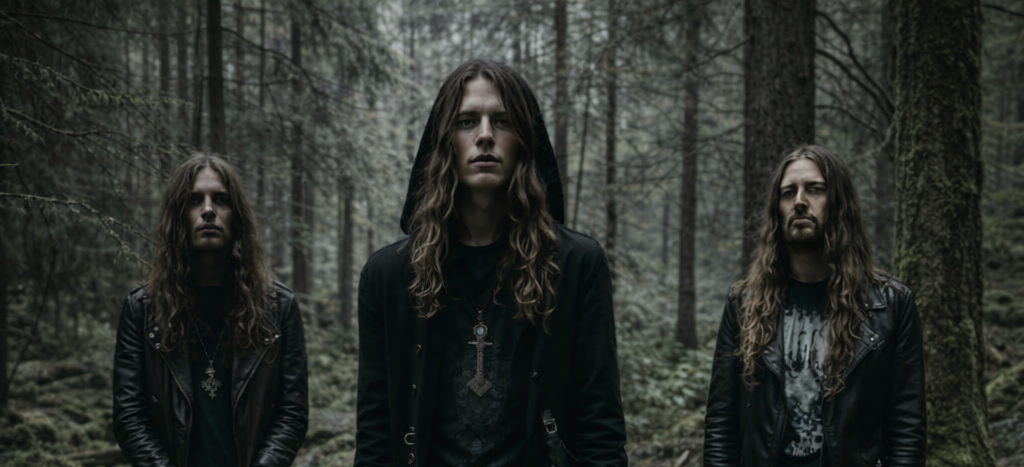
2. “The Golden Comet” feels like a prophecy. What does it signify in the journey of the forest reclaiming the world?Here is the expanded answer in English, in the same mythic, prophetic, ritualistic tone as before—now deepened with the symbolism of the Golden Comet as a sign, an omen, a metaphysical threshold rather than a physical event. “The Golden Comet” is indeed a prophecy—but not in the literal sense of a star falling from the heavens. It is a symbol, a luminous archetype, a sign that announces a turning point in the story of the world.The Golden Comet is the omen: a celestial wound tearing through the sky, marking the beginning of nature’s resurgence. But its appearance is not confined to the physical realm. It may manifest in the heavens—or it may rise from somewhere far more mysterious, from a place beyond sight, beyond matter, beyond the limits of human perception. It is the moment when something awakens. When something shifts. When the world exhales after centuries of silence. Each track on the album is a chant, a ritual step toward restoration. Together they form a path, a sequence of invocations that guide the listener toward the threshold where the forest begins reclaiming its forgotten dominion. The Golden Comet signifies an inversion of course for humanity—not imposed by fear or catastrophe, but by revelation. It is the sign that reminds human beings of what they have lost: the ability to feel the sacred pulse of the world, to recognize beauty, to be inspired by the living presence around them. Nature does not send this omen out of anger. It does not seek revenge. It does not tremble before pollution or destruction. Its sorrow lies elsewhere: in the closed human heart, in the eyes that no longer see, in the souls that no longer listen. The Golden Comet is the call to remember. A radiant signal—whether from the sky or from some unknown realm—that marks the beginning of a return, a reawakening, a reconnection. It is the prophecy of a world rediscovered. A world where the forest no longer whispers alone.
3. How do you translate the whispers of trees and the fury of storms into sound?
We don’t compose—we commune.
The forest speaks in frequencies, in vibrations older than language, and we simply become vessels through which those voices can take shape. The whispers of trees, the fury of storms, the breath of moss and stone—they already exist as music. We only translate.Human beings have always been able to communicate with the forces of nature.
This is not a gift reserved for a chosen few; it is an ancient capacity woven into our bones. For millennia, humanity lived in dialogue with the world—listening to the wind as if it were a teacher, reading the rivers as if they were scriptures, feeling the pulse of the earth as if it were a companion.That ability has never disappeared.
It has only been forgotten.All it takes is the will to listen, and a path opens.
A threshold shifts.
The silence becomes a voice again.When we enter the forest, we do not seek inspiration—we seek contact. The entities that dwell within the natural world speak to us through gentle melodies, subtle harmonics, and resonant patterns that echo through the roots and the canopy. These are not hallucinations or fantasies; they are forms of communication that precede human logic.We receive these signals, and we shape them into post‑black metal—a medium raw enough, vast enough, sacred enough to carry their message. Distortion becomes the roar of the storm. Reverb becomes the breath of the night. Silence becomes the space where the spirits move.Black metal, in its essence, is a sacred chant.
A ritual language capable of holding both the tenderness of leaves and the violence of thunder. Through it, nature expresses not anger, but longing—a lament for the human heart that no longer recognizes its own origin, its own beauty, its own belonging.Our task is simple:
to listen,
to receive,
to translate.The forest speaks.
The storms speak.
And when humanity chooses to listen again, the world will remember its own voice.
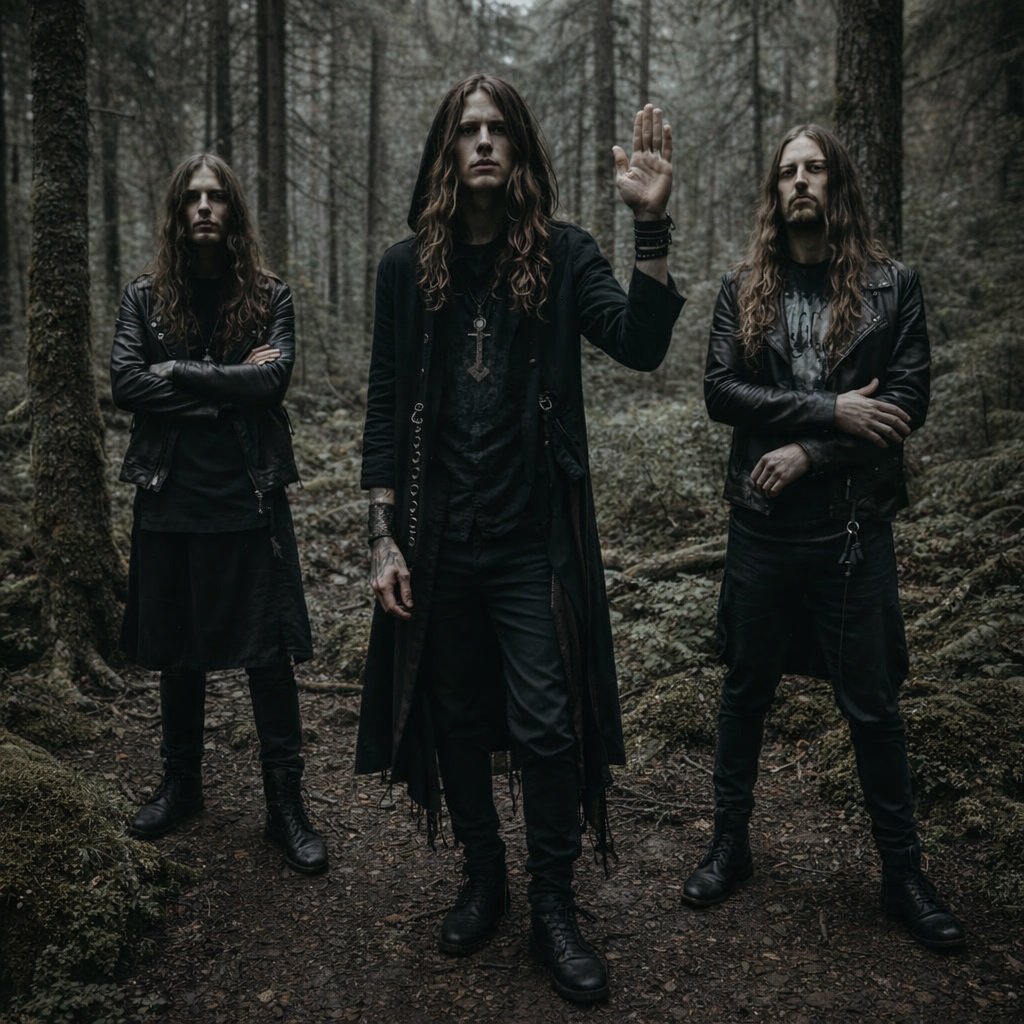
4. The forest in your music feels sentient—almost sovereign. Do you see nature as a character, a force, or a forgotten deity?
Nature is all three—
a character, a force, and a forgotten deity.
But she is also something even more profound: the most intimate part of the human being.Humanity was never separate from nature.
We were shaped by her rhythms, raised by her silence, guided by her breath. The forest is not an external entity observing us from afar—it is our origin, our mirror, our hidden self. To return to nature is not to worship something outside of us; it is to remember who we are.This is why symbiosis is essential.
We cannot live without nature—not biologically, not spiritually, not artistically. The more humanity surrounds itself with concrete, steel, and artificial light, the more it drifts away from its own source. Urbanization and cementification are not the problem in themselves; they are the manifestation of a deeper wound: the human heart closing itself to the world that created it.But this distance is not permanent.
It cannot be.Everything built on forgetting is destined to fade.
Everything erected against the natural order eventually dissolves.And in that dissolution, something ancient returns.The Golden Comet is the sign of that return.
A symbol of the turning point, the moment when humanity begins to feel again—when the closed heart cracks open, when the forgotten bond stirs, when the world whispers a reminder of its sacred origin.The Golden Comet is near.
Not as a physical object streaking across the sky, but as a shift, a revelation, a luminous omen rising from realms unseen. It marks the beginning of the reconnection between humanity and the sovereign forest—the silent monarch, the wounded oracle, the ancient mother who has never abandoned us.We do not sing about her.
We sing with her.
5. How did “The Golden Comet” take shape? Was it composed as a single vision or gathered like fragments from the woods? It came in pulses. Dreams. Whispers. Each track was a fragment unearthed from moss and memory, then bound together like a ritual map.
6. What role does silence play in your compositions? Is it absence—or presence waiting to be heard? Silence is the breath between chants. It is where the spirits speak clearest. We do not fill silence—we honor it.
7. What lies ahead for The Last Chant of the Forest? Will the spirits continue to sing through you? The forest is not done speaking. The Golden Comet was only the first flare. What comes next will be deeper—darker—more rooted. We are preparing new chants, new offerings. The spirits guide us still.
Invocation to Close Let this interview be a leaf fallen into the sacred stream. May those who read it hear the whispers beneath the words. The forest remembers. The chant continues.